15 Political Predictions 2026–2028 (as at January 2026)
These are predictions, not a crystal ball.
They are not certainties, and they are not a wish list. They do not reflect what I personally endorse or hope will happen. In many cases, they outline outcomes I would actively prefer to avoid. The point is not to argue for these outcomes, but to recognise where political incentives, pressure and behaviour are currently pointing.
What follows is based on observable patterns: leadership exhaustion, policy reversals, demographic shifts, factional manoeuvring and a growing gap between political narratives and public tolerance. None of this assumes sudden changes or dramatic coups. Most of it points to slower, quieter change. Careers ending through attrition rather than scandal. Voters disengaging not because they are radicalised, but because they are tired.
Taken together, these predictions sketch the possible shape of the next political cycle. This is analysis, not advocacy.
1. Frydenberg wants back in desperately, but it’s messy
The Senate is the cleanest path for Josh Frydenberg. Kooyong has moved on, the teal vote is locked in, and a House return would be high risk. With Kooyong tough to regain, he could try La Trobe but would need to push one of his own out. If he comes back, it almost certainly means someone else in the LNP has to go, possibly Sarah Henderson gets pushed aside and Josh takes the top spot on the Victorian Senate.
2. Hastie ends up leading the Liberals
Andrew Hastie is waiting for Ley to take the heat out of this highly charged political moment over Bondi. The real question is who will be the deputy. A Leeser pick is a nod to the Jewish community. A Price pick is all about whistling to the grievance political crowd. A Tehan pick says legacy and calm. The fact all three are plausible tells you the party isn’t ready for a Libspill just yet.
3. Immigration gets nastier, not clearer
Racism grows and the tone hardens. Pro-Israel factions, white-nationalist voices and donor politics dominate. Voters drift toward backing lower immigration not because they reject migrants, but because they’re exhausted by overseas Jewish–Muslim conflicts being imported into Australian politics. A bit like not inviting those friends or family who always fight at your parties. They don’t like being told they cannot protest and are being censored. Those on the fence on immigration, even immigrants themselves, want to shut the door.
4. Leadership changes leave wreckage behind
Sussan Ley gets sidelined and chooses not to contest the 2028 election. Ted O’Brien is also exposed. Nuclear was one of his big policy bets, and once it quietly disappears, his standing weakens. This is even more of a concern if he gets dumped from the front bench and loses the profile he enjoys. Fairfax already has an independent history. That combination makes it a seat to watch.
5. AUKUS stops being untouchable
Cost blowouts, kill-switch fears and critical minerals change the tone. The United States looks less predictable and its volatility makes the alliance feel high risk. Labor is hoping the United Kingdom blinks first so any rethink can be framed as joint, not unilateral.
6. Nuclear is done, even if they won’t admit it
It doesn’t really “come back”. There’s no workforce, no credible timeline, no cost certainty and no waste solution. After losing an election arguing for it, the Coalition simply can’t prosecute the case again. It fades and gas fills the gap.
7. Dumping net zero turns out to be a big mistake
Walking away from net zero looks bold internally and may be supported by big donors, but lands badly with constituents. This hits hard the blue ribbon seats they hoped to get back. Climate-literate, economically conservative seats don’t kick and scream. They just drift away. The fallout is slow, quiet and very hard to reverse.
8. The right keeps splintering
LNP reshuffles and chaos leave political leftovers scrambling, and some may defect. One Nation circles the chaos like a vulture, not to win House seats, but to pick up Senate spots in NSW and Victoria off fragmentation. Reform AU may even pick up some big names who have been sidelined but will struggle to gain any real traction at the booth.
9. The Senate self-cleanses
Lidia Thorpe and Ralph Babet are unlikely to contest 2028 with any realistic pathway. Protest energy burns bright but fast. Their exit opens space for more organised minor parties and reshuffles Senate maths. The Victorian Senate is going to look very different.
10. Housing blame shifts
Airbnb and immigration stop being the main villains. Attention turns to vacant homes and land banking. This lets governments redirect blame and talk about supply hoarding rather than structural failure.
11. The NDIS becomes a political headache
The “thriving kids” program fails under scrutiny. Labor gets trapped between trying to save money and trying to keep the scheme legitimate. Families, advocates and states push back, and the media keeps it front of mind.
12. Big names step aside and the baton passes
By 2028, Anthony Albanese has taken the heat and steps aside. Penny Wong exits after completing her legacy arc. Ley is retiring. Richard Marles takes over as continuity, not renewal.
13. Ryan at risk as “the one that got away” for the Greens
Elizabeth Watson-Brown retires and Ryan opens up. The Greens struggle to look like a worthwhile option after the last election. Also hurt by Thorpe (Senate), Franks (SA) and Burnet (Tas) resigning to be independents, voters see it as a wasted vote. They lose faith that candidates will stay party-aligned. The next problem is what to do about Max Chandler-Mather. Do they push him towards the Senate, parachute him into Ryan or find another opportunity? They definitely want him back and when they do he will take over as leader and attempt to re-energise the party.
14. The Royal Commission into Bondi becomes unavoidable
The Royal Commission into Bondi may become such a hot potato that Albanese agrees to one simply to put out the fire from the media and lobby groups. This is likely to cause more harm to the very people it is supposed to protect. Scrutiny on antisemitism is going to thrust the genocide in Gaza from media narratives into the realm of facts. Public opinion could force the government to consider sanctions or other measures. The Voice has demonstrated Australians don’t want special treatment for any cohort of the community no matter how much you demand it. Public support for Israel weakens dramatically.
15. Trump does not serve a full term
Trump does not serve the full term. His departure fractures the Republicans and MAGA is reduced to smaller, conspiracy-focused groups. The Republicans try to install Matthew McConaughey as a new populist pick.
Now we watch and wait. Some people will see this current landscape as an opportunity, or feel compelled to get more involved, much like we saw with the rise of independents in recent years. Others will simply zone out. What has changed is that politics is no longer just for the nerds or the insiders. It’s mainstream. Everyone has an opinion, everyone has a feed, and everyone has a threshold for nonsense. The parties aren’t just competing with each other anymore. They’re competing with disengagement, distrust and a public that is far harder to win over than it used to be.
If you made it this far, your reward is first dibs at our next event a live Q&A with Doug Cameron in February. With everything shifting, it’ll be interesting to hear his take on where politics is actually heading, beyond the media drama.
Register here: https://www.electandreflect.com.au/online-qa-with-doug-cameron/


Who is next?
No one should be surprised about Barnaby. What is interesting now is how One Nation is circling the Coalition like a predator picking at a wounded animal. They can smell the weakness. When they hint that another high profile is ready to move, it makes you wonder who might it be.
Victoria is wide open. Lydia Thorpe is out and unlikely to return as an independent, which leaves a Senate vacancy that the Greens may struggle to reclaim without a strong public face. A loose seat like that is exactly the sort of opportunity fringe parties try to exploit when the major parties are distracted.
Alex Antic is also on my radar however with a safe seat till 2031 he has less need to make any big moves. Sticking around to climb the ladder of what is left of the Liberals could be a power move while sitting still.
None of this says any of them will jump, but the right is in chaos and it doesn’t look like its over. The Coalition is bleeding confidence. Figures on the conservative fringe are unsettled. And the far right has learned to move in when the bigger party is weak. If One Nation really has another MP in its sights, it is because the Coalition has left too many of its own out in the cold.
Published 8 Dec 2025
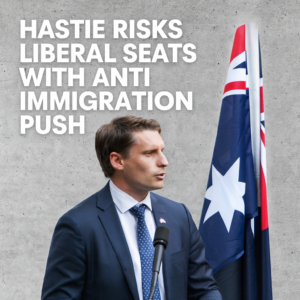
Hastie risks Liberal Seats
Andrew Hastie keeps talking tough on migration, but the math ain’t mathing. Australia’s birth rate has collapsed. Without migration our population shrinks, our workforce dries up and the economy weakens. Yet he is doubling down on anti immigrant politics while, according to Sky News, seeking a staggering $275,000 in donations to push that message nationally.
And this matters even more because Hastie is now widely predicted to take over the Liberal leadership. If this is the direction he wants to lead the party, the Liberals are steering straight into a storm.
That is not just reckless, it puts the party in a position that it could lose more seats they need to hold.
Start with the clearest warning signs.
Goldstein
Tim Wilson holds this by just 0.1% after Zoe Daniel fell short by only a few hundred votes in 2025. She lost by such a tiny margin that winning it back is well within reach. Goldstein is highly educated, globally connected and deeply multicultural. About 32% born overseas and more 54% with a parent born overseas. If the Liberals drift into hostile migration talk, Wilson is defending a seat that will be almost impossible to hold.
Mitchell
Alex Hawke sits on 3.8% in one of the most multicultural Liberal electorates in the country. Roughly 38% overseas and about 65% with migrant parents. This is textbook teal or independent territory. One strong challenger and Hastie’s rhetoric could see the seat could flip.
Berowra
Julian Leeser holds Berowra on a 1.6% margin. Around 29% of locals were born overseas and nearly 49% have a parent born overseas. This is a community of professionals, diverse families and voters who expect competence, not culture war politics. Leeser already walks a tightrope between his moderate base and the party’s hard right. Hastie’s anti migrant messaging turns that tightrope into a political trapdoor.
And those three are only the start.
La Trobe, Casey, Bowman, Lindsay, Longman and even Cook. All seats with growing multicultural communities. All seats where anti migrant politics backfire.
Hastie’s push is not clever strategy. It deepens internal rifts. It corners moderates. It recreates the exact conditions that sparked the teal wave. And it signals to multicultural Australians that the Liberal Party is willing to raise millions of dollars to campaign against their identity and contribution.
Goldstein, Mitchell and Berowra are the flashing warning lights. Ignore them and the whole vehicle breaks down.
Australia cannot shrink its way to strength. And no party can win by running against the voters own identity.
Published 7 Dec 2025